Text and images: Cornelia Falknäs
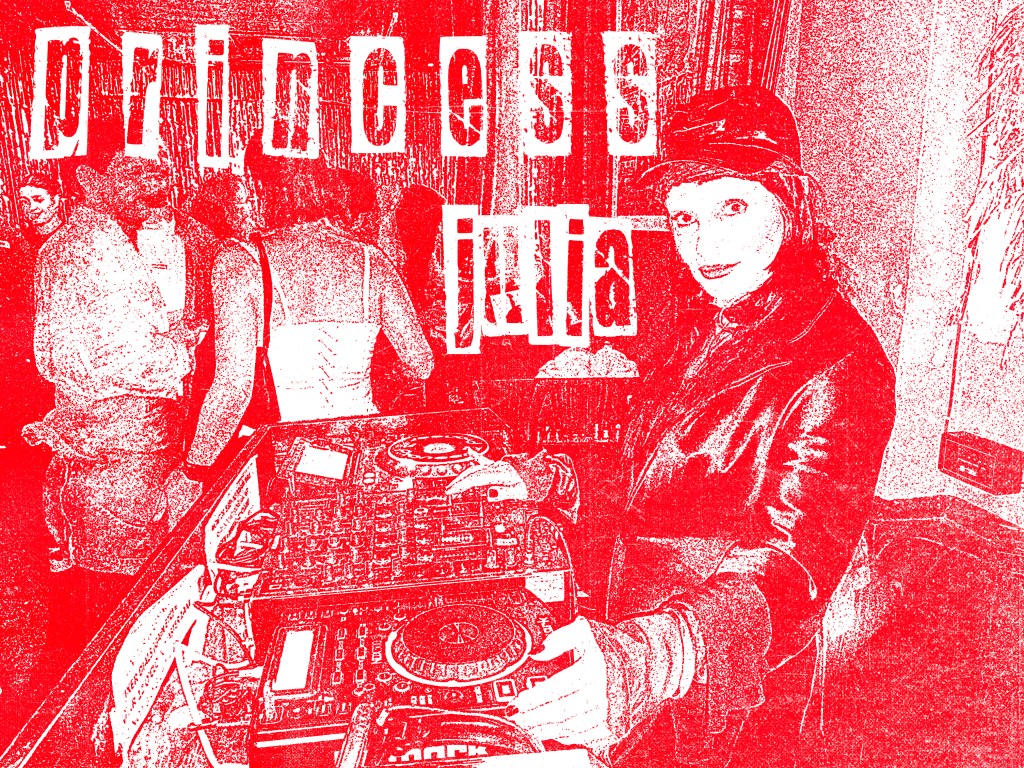
“It was quite a gender-fluid, outrageous situation,” Julia Fodor says as she looks back at the glam rock era that was part of her first exploration of adulthood. At the age of 12, she was already looking towards the world of music, captivated by the stars showcased in magazines and on TV. Growing older, she would go on to become a successful DJ under the name Princess Julia, and several decades later her reign over the London nightlife continues.
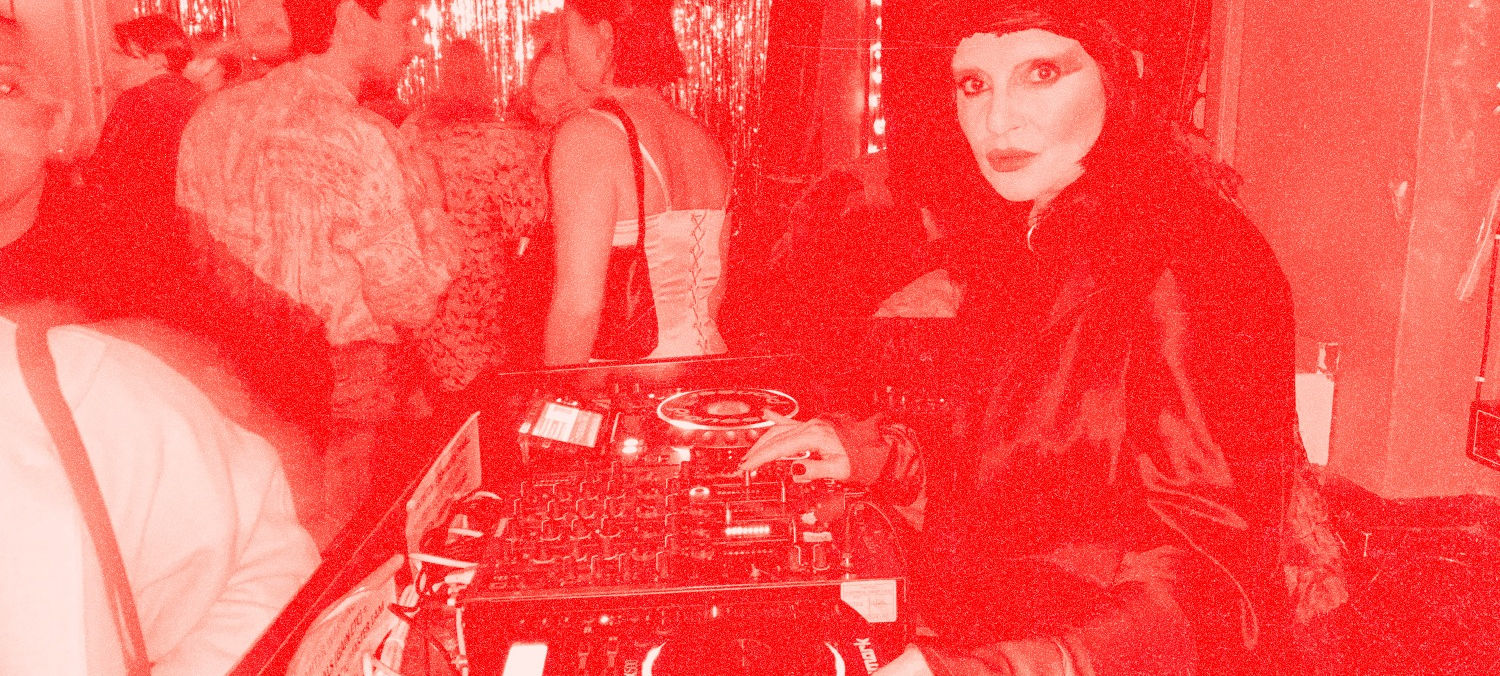
Whether you recognise her from Visage’s Fade To Grey music video, from DJing at Gay Times awards or just from the swarm of creative people frequenting iconic nightly venues in London (such as the gay pub The Glory which she calls her “fun community spot”), she is truly a sight to behold. With her dramatic makeup and extravagant outfits, Julia stands out anywhere. Especially so in the grey and gloomy little room at the library where we sit down to talk. She always makes an effort, today with a striking smokey eyeshadow and a leather and mesh outfit. Not for nothing is she called the first lady of London’s fashion scene.
“My objective is not the dream of living in hetero hell”
“You know, growing up, your parents would go ‘you’ll grow out of that, you’re gonna settle down,’” Julia remembers. Despite what her parents said she’s never become bored of the glamorous creative club scene that she’s been part of for most of her life. “My objective is not the dream of living in hetero hell and having babies and all that business. I mean, I sort of thought of it, but I wasn’t enticed by it one iota,” she laughs.
“You’re considered not a successful human unless you do those very mundane things,” Julia proceeds, referring to the stereotypical family lifestyle. She throws her head back in laughter as she recalls how some friends told her to “get a real job”, which she thinks is ridiculous.
“I’m self-employed, I’m a DJ,” she says and mentions that people sometimes get surprised that she pays taxes like everyone else. “It’s a proper job! Who’s to say it isn’t!?”
“I think maybe the idea of a proper job, like a nine to five job, is something that the silent generation got brainwashed into, you know, you do your job, whether you like it or not. And then at the end of your working life, you get a pension, and that is some sort of comfort to you, but I’ve never really felt that it’s scary not to live like that.”
“I’m in a great community that I really feel part of, and I think it’s really inspiring”
The precariousness of making a living as a creative clearly isn’t a big concern for Julia, but she recognises that self-motivating can sometimes be a challenge. “It can be like ‘Oh, God, what am I doing? Who knows? Why am I doing it? Does it matter?’ But you just have to crack on, the penny will drop somewhere, and you’ll go, ‘oh, yeah, that’s why I’m doing it.’”
Personally, Julia rarely struggles with finding inspiration: “I just feel like I’m in a great community that I really feel part of, and I think it’s really inspiring.” In fact, her experience is rather the opposite, with so many interesting opportunities around every corner that it can get somewhat exhausting. “Sometimes I do get a bit tired, but I think maybe that’s just the humaneness of wear and tear. There’s so much going on that I’m interested in that physically, I can’t really keep up with it. I think everyone would find that.”
“I maybe manifested my life to be connected to some high drama, glamour, sort of interesting world that I wasn’t really a part of”
Julia grew up in northeast London, and she points out that “the epicentre of everything that was going on”, populated by people such as David Bowie and Marc Bolan, actually wasn’t that far away in theory. “But in my mind, mentally, it was a million miles away from my humdrum existence of school life and uniforms and boringness, with sort of glimpses of hope on the horizon. So I maybe manifested my life to be connected to some high drama, glamour, sort of interesting world that I wasn’t really a part of.”
Her love affair with clubs began in the mid-70s, when she met a group of people involved in the punk scene. Today Julia frequently DJs in clubs, but early in her youth she used to do coat check, for example at the historic Blitz club, where the New Romantic scene emerged in the late 70s. “Then Boy George got the job after me. We’ve all been down the coat check. Have you done it? Do coat check, you get to meet lots of people!”

Julia doesn’t want to dwell too much on the past. She says that she used to find it quite hard to talk about the different subcultural movements she’s been involved with, but now thinks that it’s a fabulous legacy to carry on. When she was asked to participate in documentaries about the period, she understood that “it’s actually quite important that various sectors of the community do stand up to do it because otherwise just white straight men will”.
“… the straight white boys, they don’t do anything. They just get all the cheers for it”
“They’re always bustling forward, getting all the approval and acclaim,” she says. “It is all the straight white men that seem to be the ones that are cultivating the scenes and that’s not necessarily true. In fact, it’s not true at all.” Julia laughs as she proceeds to say that the “straight white men” frequenting these scenes were actually “just the eye candy”.
“I mean they are nice people and I’m still friends with them. But they do come up with some funny things sometimes. I’m like ‘I can’t believe you’re even saying that!’ Because, you know, in actual fact, in all of these scenes, there’s always been really powerful women, and really powerful queer activity, LGBTQ+ moments, always, always driving these clubs to be the most fabulous and it isn’t the straight white boys, they don’t do anything. They just get all the cheers for it. It was us lot making it fabulous, not them.” When she participates in documentaries Julia gives the production a list of people she thinks are important for them to talk to: “There are other voices in the community that were there, it wasn’t just your token Boy George, and then a bunch of straight blokes.”
“When I started it was a real boys club”
The queer scene is where Julia is happiest. She was shocked by the sexism she faced as a female DJ when exiting her “bubble in the gay scene” in the 90s to DJ at raves around Europe. “People weren’t as welcoming, they made it into a thing,” she says. Sometimes people even sabotaged her sets by hijacking the mixer before she went on, “so it sounded all dodgy” when she was playing.
Today, Julia considers the DJ profession to be demystified compared to how it used to be. “When I started it was a real boys club, boys like to make it sound really complicated,” she says. “We’re always brainwashed into this idea that women aren’t technological, and can’t work technology, which is such a pile of old bollocks!” Julia stresses that “anyone can be a DJ, you can be a DJ, anyone can do it!” but at the same time she says that she feels lucky to still be able to DJ regularly.
“I just like seeing people dancing and having a good time. I want to be in the middle of it all, it’s just a nice feeling. And also music is a thing that brings people together and it sounds really cheesy, but I just like that idea that everyone is in a space unleashed, and enjoying themselves. If I can do that, it makes my job worthwhile.”
Princess Julia has now been a royalty of the global club scene for over 45 years, and she says that she sees life as a learning curve. “I like being woke. I like it, I’m into it. If I don’t know about something or I’ve got something a bit wrong, I’m quite happy to be called out. Not necessarily cancelled, because I hope that I would learn, but I’m willing to change my ideas and be open-minded about things… I think it’s much better to be considerate of other humans and look at their story with open eyes, because I do feel humans are really quite nasty to each other.”

“I love human interaction, especially when it’s hilarious”
She shares some of the savvy she has acquired along the way: “I’ve always felt the same really; you can’t get on with everyone, not everyone’s gonna be your bezzie mate. There’s going to be people that don’t like you and there’s going to be people that adore you. It’s best not to really worry what other people think, that’s my opinion, just don’t give a fuck. Just do whatever you’ve got to do with conviction… I’m like a self-help book!” she exclaims, giggling. “I’ve always had that sort of idea. If something doesn’t feel right to you just walk away. I mean, maybe that’s something that I’ve learnt; not to get too embroiled in things. Not to get caught up in the drama too much, because I do love a drama, I love human interaction, especially when it’s hilarious. But with social media and things, it’s really very hard to not get caught up in online drama.”
As a lover of human interaction, Julia likes to take on the role of a creative match maker. “A lot of the time I do things, and I’ll sort of take the backseat really. I’m interested in helping people and making things go forward. So I do sort of suggest ‘you should work with that person because I think you’d really get on’ and sometimes they do and they do great things out of it. In my own small way I encourage people coming out to explore their creative things,” she explains, and says that she is proud of contributing to the creative development of others. “Sometimes people do go on to become super famous and high profile or they become big in their area. And I feel like maybe I’ve had a part of that journey in my way, been a part of that story, their story.”
“Clubs aren’t the be all and end all. But they are interesting places to have exciting adventures”
As for her own future, Julia certainly has a lot going on, but she doesn’t like mapping it out too much. “Expect the unexpected, and go with it. That’s my advice. You can have a life plan, people do, you know, they go, like ‘in five years I’m gonna be doing that’, they project an idea of what they might be doing. I find that a bit too rigid.”
“I don’t know if I’ve got any grand plans, as such. Working out more looks, doing more pose, you know…” she laughs. And although she refers to the clubbing life as something quite demanding, she doesn’t seem to have any plans on stepping down from her party princess throne just yet: “Working in clubs is quite a transient job really, because it’s quite a high impact type lifestyle to maintain, it’s exhausting. It’s a lot of temptations along the way that you get drawn into. But that’s quite exciting, if you’re a danger queen, or you like an element of excitement, or just like throwing yourself open, exploring different lifestyles. But it is easy to run into some trouble, and it’s not for everyone. Most people have a period of their lives when they have the energy to go out to things, clubs, events, and then you’ve got to pace yourself with it a bit. I probably wouldn’t go out to clubs so much if I wasn’t really working in them, and it didn’t excite me so much, but I still really like doing it… Clubs aren’t the be all and end all. But they are interesting places to have exciting adventures, and be sort of reckless, in a hopefully safe space.” ★
 Cornelia Falknäs